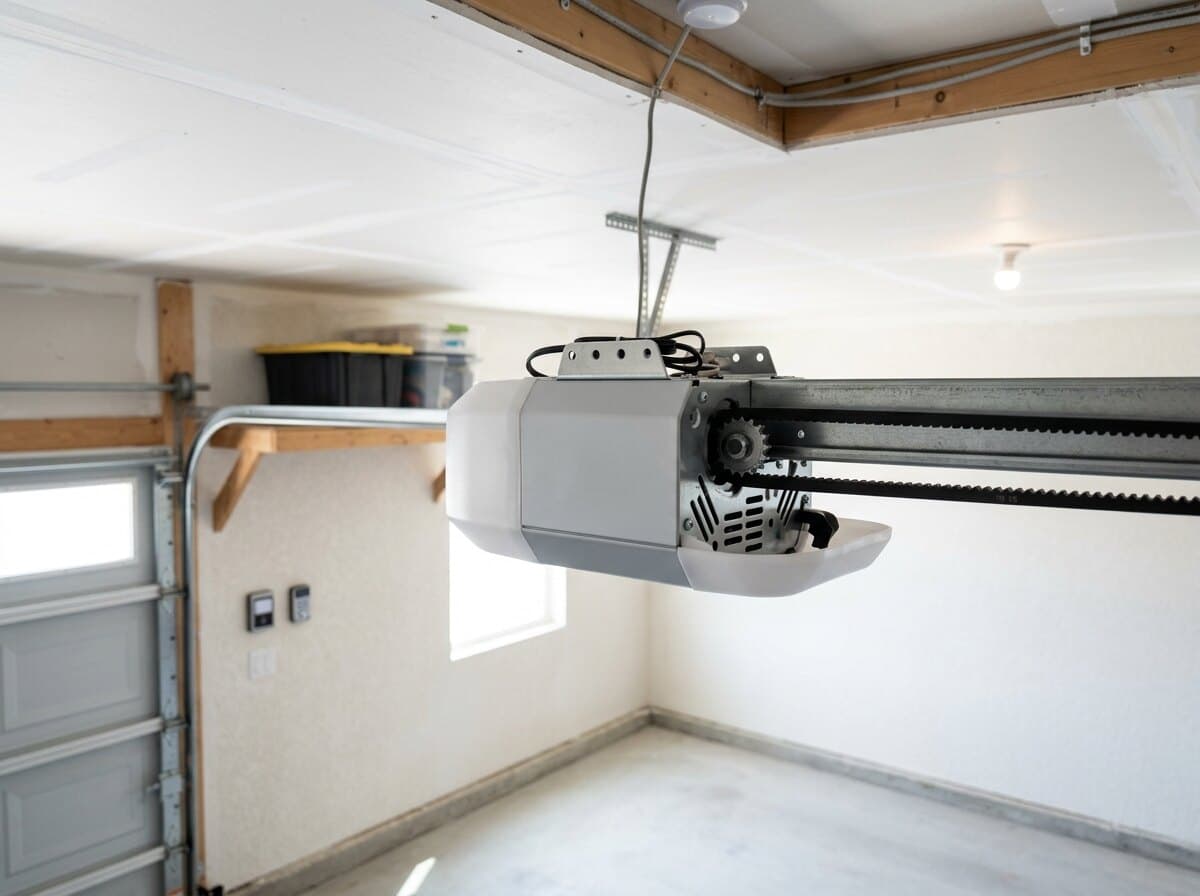
When the opener stops working
A garage door opener that stops responding, struggles to lift the door, or behaves inconsistently is one of the more frustrating home problems — particularly because the garage is often the primary entry point for the house.
Before assuming the opener is dead, it is worth separating the opener from the door. A garage door that has become difficult for the opener is usually a door problem, not an opener problem — worn springs, a balance issue, or stiff rollers putting more load on the opener than it was designed to carry. We'll test the door manually first. If the door lifts easily by hand but the opener will not move it, the opener is the issue. If the door is heavy by hand, the door needs attention before the opener conversation.
That distinction matters because buying a new opener and installing it on a door with a bad spring just accelerates the wear on the new opener.
What we do with openers
New opener installation We sell and install garage door openers for residential and commercial applications. If you are replacing a failed opener or installing one for the first time, we will help you pick the right opener for your door weight, size, and use.
Not all openers suit all doors. A door that weighs 200 pounds or more, or a door that is used frequently, needs a unit with an appropriate horsepower and duty cycle rating. We carry openers appropriate to the range of doors we install and service in Carbon County.
Opener repair Openers fail in specific ways: the drive mechanism wears out, the circuit board fails, the trolley strips, the limit switches drift, the safety sensors go out of alignment. Many of these are repairable without replacing the whole unit. We'll diagnose what is actually failing and give you a straight answer on whether repair makes sense or replacement is more practical given the unit's age.
Safety sensor adjustment and replacement The two photoelectric sensors at the bottom of the door tracks are required on all residential openers manufactured after 1993. They prevent the door from closing on a person, pet, or object in the path. When they go out of alignment — from a bump to the track, a dirty lens, or a wiring issue — the door will not close completely or will reverse mid-travel. This is a common repair call and usually a quick fix.
Remote and keypad programming New remotes, keypad entry units, and smart home integration. If you have lost a remote, need an additional one, or want a keypad outside the door, we can handle the hardware and programming.
Wall console and wiring issues A wall button that has stopped responding is usually either the button itself or a wiring break between the button and the opener head. Both are diagnosable and repairable.
Opener types
Chain drive The most common residential opener type. A metal chain moves the trolley along the rail. Durable and reliable, but noisier than other drive types. A reasonable choice for a detached garage where the noise does not carry into living space.
Belt drive Uses a rubber or fiberglass belt instead of a chain. Quieter operation. A good choice for an attached garage where the opener is directly below a bedroom, living room, or home office.
Screw drive A threaded steel rod rotates to move the trolley. Fewer moving parts than chain or belt drive, which means less routine maintenance. Performance can vary in extreme temperatures — not always the first choice in a Carbon County garage that reaches single digits in January.
Direct drive The motor itself travels along a stationary chain, which reduces vibration and is very quiet. Common in higher-end residential applications.
Jackshaft openers Mounted to the wall beside the door rather than overhead, jackshaft openers are the right solution for garages with low ceilings or unusable overhead space. They drive the torsion bar directly. Common in commercial applications; used residentially when ceiling height requires it.
Commercial openers
Commercial applications — service bays, warehouses, storage units, parking structures — require openers rated for higher cycle counts and heavier door weights than residential units. A commercial-duty opener running 30 cycles per day on a heavy rolling steel door has completely different requirements than a residential opener on a two-car garage. We sell and install commercial openers appropriate to the application. Call for a consultation.
When it makes sense to replace vs. repair
A 20-year-old opener that has developed multiple issues is usually not worth repairing. Parts availability gets thin, the circuit board technology is outdated, and a repair that fixes the immediate problem often precedes another failure in six months. We'll tell you the age and model of your opener and give you an honest assessment of whether repair or replacement makes sense economically. We're not trying to sell you a new opener you do not need.
Conversely, a five-year-old opener with a single sensor failure is a repair, not a replacement.
Get an opener installed or repaired
Call (610) 826-2400. Describe what your opener is doing and the age and size of your door if you know it. We'll tell you what the repair or replacement looks like and whether we can handle it in the same trip as the diagnosis.
We serve Palmerton, Jim Thorpe, Lehighton, Nesquehoning, Lansford, the rest of Carbon County, Monroe County, and the Lehigh Valley.
Palmerton Garage Door II LLC 3785 Forest Inn Road, Palmerton, PA 18071 (610) 826-2400 palmdr2@gmail.com
Seven-time Times News Best Garage Door Company. Carbon County's own since 1991.