Call (610) 826-2400. Broken spring calls get priority scheduling.
Your door stopped working — here is why
When a garage door refuses to open in the morning — either the opener strains and gives up, or you pull the release cord and the door is too heavy to lift by hand — the spring is almost certainly the reason.
Garage door springs are the counterbalance system. They store mechanical energy when the door closes and release it when the door opens, which is why a properly balanced door lifts so easily. A standard double-car garage door weighs between 150 and 200 pounds. The spring carries most of that weight every time the door moves. When the spring breaks, that weight lands directly on the opener or on your arms — and most openers are not built for it.
You may have heard a loud bang from the garage. That is what a torsion spring failing sounds like. If you did not hear it happen, the first sign is usually that the door will not open, or opens only a few inches before the opener disengages.
Torsion springs vs. extension springs
There are two types of residential springs, and the repair is different for each.
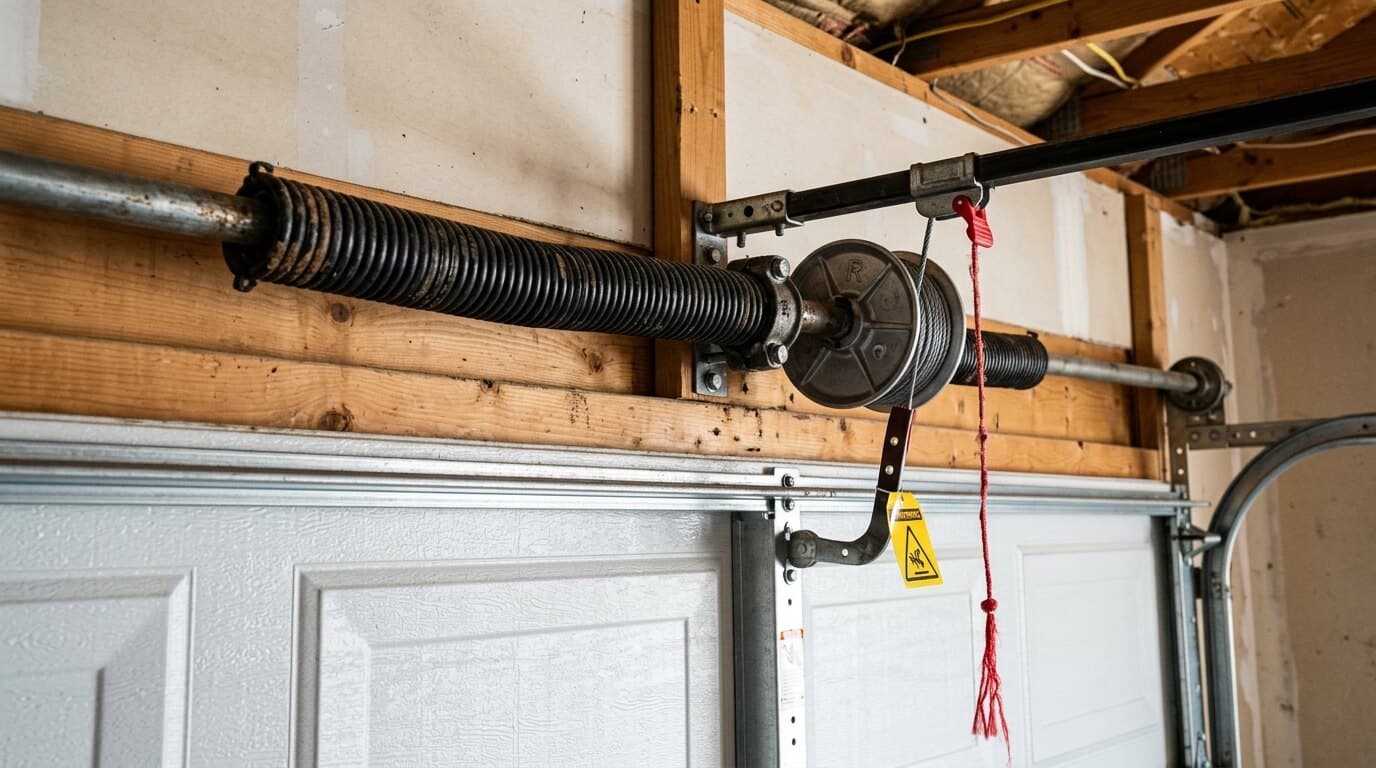
Torsion springs sit horizontally above the door on a metal shaft. They twist when the door closes and unwind when it opens. Most doors installed in the past 20 to 25 years use torsion springs. They are generally more durable than extension springs and break more predictably — usually at the end of their rated cycle life rather than from sudden shock.
Extension springs run along the upper horizontal tracks on either side of the door. They stretch when the door closes and contract when it opens. Older homes are more likely to have extension spring systems. If your door has a spring running along the track with a safety cable threaded through it, that is an extension spring.
Both types can break. Both require professional replacement. The tension involved — especially in torsion spring systems — means this is not a repair for a ladder and a YouTube video.
How long do garage door springs last?
Most residential garage door springs are rated for 10,000 cycles. A cycle is one opening and one closing. If your household opens and closes the garage door four times a day, a 10,000-cycle spring lasts roughly seven years. Higher-cycle springs rated at 25,000 or more are available and cost more upfront but last significantly longer.
Springs that were installed when the door was new often reach the end of their life at the same time as other components. If your door is 10 or more years old and the spring breaks, it is worth asking whether the rollers, cables, and hardware are due for inspection at the same time.
Do not try to adjust or repair a broken spring yourself
Garage door springs are under significant pre-wound tension even when a door is sitting at rest. A torsion spring that snaps loose from an improperly wound setup releases that energy suddenly and without warning. The combination of a rotating shaft and a spring under several hundred inch-pounds of torque can cause serious injury.
If your spring has broken, leave the door in its current position and call a professional. Do not try to force the door open past the broken spring. If the door is partially open, do not try to close it manually — the weight distribution is off and it can drop.
What to expect when you call us
When you call (610) 826-2400 and describe a broken spring, we'll ask a few questions: the rough size of the door, whether it is a torsion or extension system if you know, and whether the door is stuck open or closed. This helps us come prepared with the right spring size and hardware.
Same-day response for broken spring calls is common, depending on schedule and your location in Carbon County, Monroe County, or the Lehigh Valley. We carry common spring sizes and can often complete the replacement in a single visit.
What the replacement includes:
- Remove the broken spring
- Install a new spring of the appropriate size and cycle rating
- Check and adjust cable tension and drum alignment
- Inspect cables, rollers, and hardware for wear while the system is apart
- Test door balance manually (should lift smoothly with two fingers)
- Reconnect and test the opener
Should I replace one spring or both?
If your door has two springs (one on each side of the torsion bar, or one extension spring per side) and only one breaks, you will often hear the recommendation to replace both at the same time. Here is why: if one spring has reached the end of its cycle life, the other has likely accumulated similar wear. Replacing both now saves a second service call in the near future.
We'll tell you the condition of the second spring and give you the option. We won't insist on replacing both if the second spring shows no signs of wear — but we'll be honest with you about what we find.
What broken spring replacement costs in Carbon County
Torsion spring replacement for a standard residential door typically runs between $150 and $300 for a single spring, depending on the spring size and what else is found during the inspection. Replacing both springs at the same time, if the second is worn, runs somewhat more. Extension spring replacement is generally on the lower end of that range.
Those are real working numbers for Carbon County. If your job involves non-standard spring sizes, a large commercial door, or additional hardware replacement, the cost goes up and we'll quote it before the work starts.
Call us when the spring breaks
We serve Palmerton, Jim Thorpe, Lehighton, Nesquehoning, Lansford, Kunkletown, Walnutport, Slatington, the rest of Carbon County, and into Monroe County and the Lehigh Valley.
Call (610) 826-2400. Broken spring calls get priority scheduling. We will tell you honestly whether we can get there today or what the wait looks like.
Palmerton Garage Door II LLC 3785 Forest Inn Road, Palmerton, PA 18071 (610) 826-2400 palmdr2@gmail.com
35 years of garage door service in Carbon County. Seven-time Times News Best.