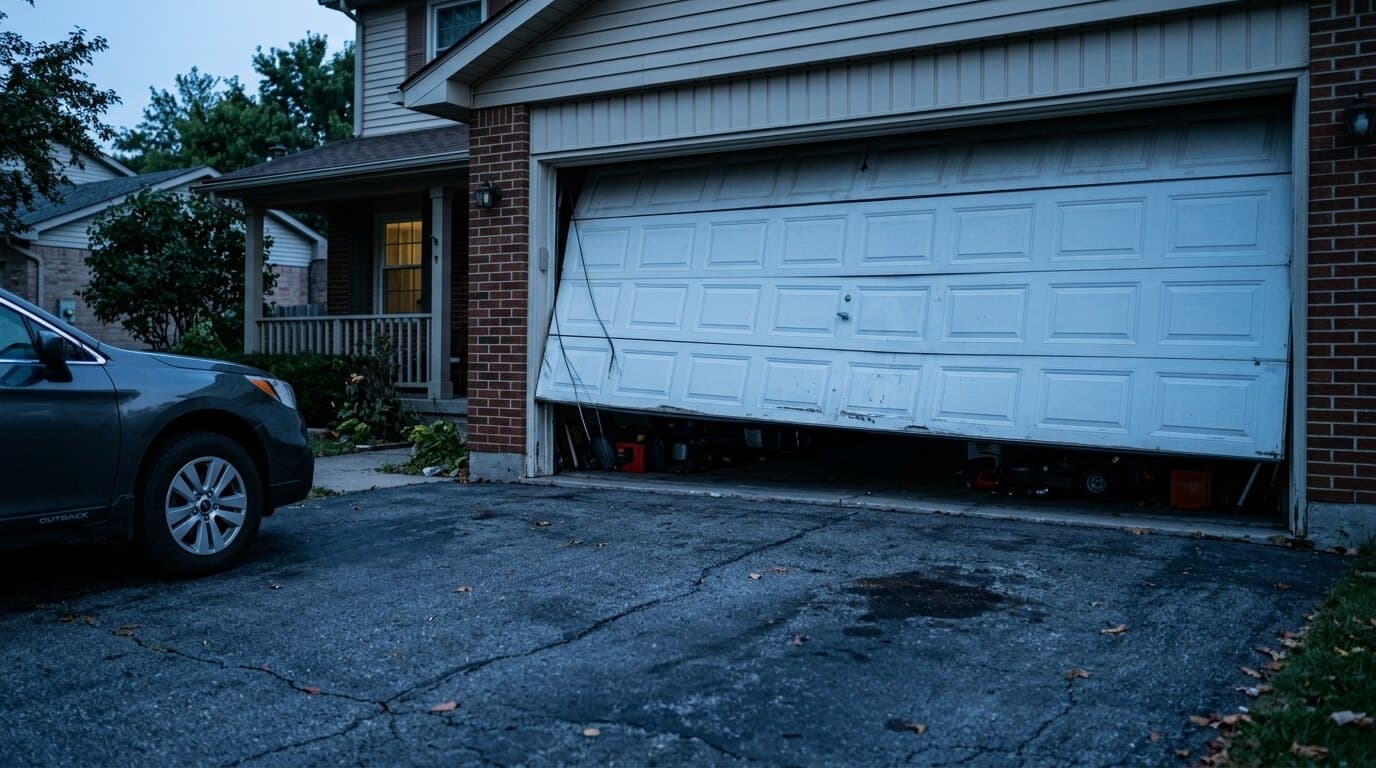
It usually starts with a loud bang from inside the garage. Sometimes at 6:45 in the morning when the car needs to be out of the driveway. You hit the opener button, the motor runs, and the door barely moves — or does not move at all.
The spring broke.
This is the single most common emergency call Palmerton Garage Door II LLC gets across Carbon County. Ryan Bruch has replaced hundreds of them. Here is what you need to know right now: what the spring is, why it broke, what is safe to do yourself, what is absolutely not, and what a professional replacement looks like.
What the spring actually does
Every garage door has a counterbalance system. A standard residential door — a 16-foot double car door in steel — weighs somewhere between 150 and 250 pounds depending on the material and whether it is insulated. The door needs to lift that weight smoothly, preferably with two fingers of effort when disconnected from the opener.
The spring makes that possible. It stores mechanical energy when the door closes — winding tight or stretching under tension — and releases that energy when the door opens. The opener's job is to move the door along the track. The spring's job is to make the door nearly weightless by counterbalancing most of that 150 to 250 pounds.
When the spring breaks, the counterbalance is gone. The opener is suddenly being asked to lift the full weight of the door alone. Most residential openers are not designed for that. Many will try, strain, and trip the thermal overload. Some will move the door a few inches before the motor cuts out. Some will not move the door at all.
That is what you are experiencing when the opener runs but the door barely moves.
Two types of springs — and how to tell which you have
Torsion springs sit horizontally above the garage door, mounted on a metal shaft that runs the full width of the opening. When the door closes, the spring winds up (torque is stored). When the door opens, the spring unwinds and transfers that stored energy to the cables and drums that lift the door.
You can identify a torsion spring by looking above the closed door. If you see a horizontal metal shaft with a spring coil wrapped around it, that is a torsion spring. Most doors installed in the past 20 to 25 years use torsion systems.
Extension springs run along the upper horizontal tracks on each side of the garage. They stretch when the door closes and contract when it opens. Older homes — particularly those built before the 1990s — are more likely to have extension spring systems. If you see a spring running along the horizontal track with a cable or chain threaded through it, that is an extension spring.
When a torsion spring breaks, you will often hear a sharp loud bang — the spring snapping under tension. The break point is usually visible: look above the door and you will see the spring with a gap where it separated. When an extension spring breaks, the loose end may hang free or coil up on the safety cable.
What is safe to do right now
Check which way the door is stuck. A door stuck in the closed position is less urgent than a door stuck open. A stuck-open door is a security and weather problem — the garage is exposed until the door is repaired. If the door is open and you cannot get it down, call (610) 826-2400. We prioritize stuck-open calls.
Disconnect the opener from the door (if the door is in a position where it will stay without the opener) by pulling the red emergency release cord that hangs from the trolley above the door. This disconnects the door from the opener carriage and lets you determine whether the door will hold in place without power. Do not pull the release cord if the door is partially open — it may drop suddenly without the opener holding it in position.
Lock the door manually if it is closed and you can reach the manual lock. This prevents the door from being lifted from the outside while the spring is out of service.
Leave the door alone otherwise. Do not try to force it open by hand. Do not try to manually wind the torsion spring. Do not remove the cable from the drum to "free" the door. These actions can cause the door to drop suddenly, the spring to release stored energy uncontrollably, or components to fail in ways that cause injury.
What not to touch: the safety reasons in plain terms
Garage door springs are under serious stored tension. This is what makes them useful — but it is also what makes them dangerous when handled incorrectly.
A torsion spring on a standard residential door stores energy equivalent to roughly 100 to 300 foot-pounds of torque or more, depending on the spring size and the door weight. When that energy releases in an uncontrolled way — a winding bar slips, a set screw gives, a spring snaps during an improper replacement attempt — it releases suddenly and with significant force.
Extension springs that are not installed with safety cables are an additional risk. A safety cable threads through the spring and anchors at both ends. If the spring snaps, the safety cable contains the coil so it does not become a projectile. If the spring has no safety cable, a break can send a heavy steel coil across the garage at speed. If your extension springs do not have safety cables, mention it when you call — it is worth noting.
The short version: leave torsion spring work to professionals with the right tools, the right technique, and experience with the specific torque loads involved. This is not a repair for a ladder and a wrench.
Should you replace one spring or both?
If your door has a standard two-spring torsion setup (one spring on each side of the center bracket on the shaft) and one spring breaks, you will often hear the recommendation to replace both at the same time.
Here is the reasoning. Springs are rated for a certain number of cycles. If one spring has reached the end of its cycle life, the second spring has been through nearly identical wear — same door, same daily use, same number of open-and-close cycles. Replacing only the broken spring leaves the second spring at the same age and mileage, likely to break in the not-too-distant future.
Replacing both springs in the same visit costs somewhat more than replacing one, but it saves a second service call and a second broken spring situation six months or a year later. Ryan will tell you the condition of the second spring while the system is apart and give you the choice — he will not pressure you either way, but he will give you an honest assessment.
What a professional spring replacement looks like
Ryan arrives and looks at the door and the spring system. He will ask about the door size, how long it has been in service, and whether there has been any recent change in how it operated before it stopped. This helps him come prepared with the right spring size and hardware.
For a torsion spring replacement:
- The broken spring (and second spring if you are replacing both) is removed from the shaft
- The new spring or springs are installed on the shaft
- The springs are wound to the correct tension for the door weight — this requires a winding bar and knowledge of the correct number of turns for the spring size
- Cable tension and drum alignment are checked and adjusted
- The door is disconnected from the opener and tested manually — it should lift smoothly with two fingers of pressure at the midpoint of the door
- The opener is reconnected and the door is run through several cycles under power
- Ryan checks the auto-reverse function and the opener limits before leaving
The full repair usually takes one to two hours.
How much it costs in Carbon County
Torsion spring replacement for a standard residential door typically runs $150 to $300 for a single spring. Replacing both springs at the same visit is somewhat more. Extension spring replacement is generally on the lower end of the single torsion spring range.
These numbers include labor. Ryan will give you a specific quote when he sees the door.
Call when it breaks
We serve Palmerton, Jim Thorpe, Lehighton, Nesquehoning, Lansford, Kunkletown, Walnutport, Slatington, and the rest of Carbon County.
Call (610) 826-2400. Broken spring calls get priority scheduling — we know this is not a problem you can put off until next week when your car is in the garage. Ryan will tell you what the response time looks like when you call.
Palmerton Garage Door II LLC 3785 Forest Inn Road, Palmerton, PA 18071 (610) 826-2400 · ryan@palmertongarage.com
35 years in Carbon County. Seven-time Times News Best Garage Door Company.